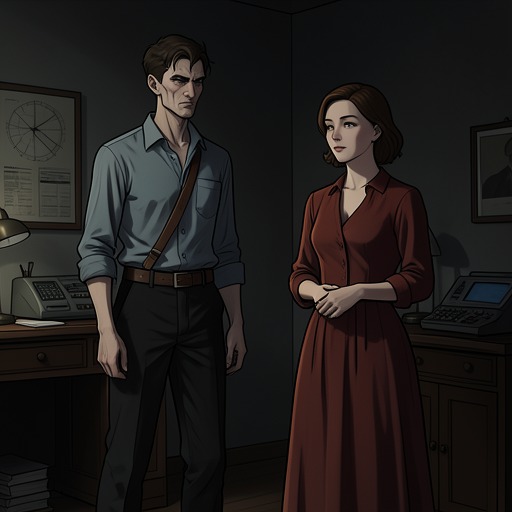
Luc’s Retired-Hero Status
The Reincarnated Demon King's Host Just Wants to Live in Peace, But the Hero Won't Leave Him AloneLuc’s retired-Hero status is a choice about what his duty means, not a simple renunciation of it. Once Malthios has destroyed the Demon Fortress and says that the remaining threat no longer requires a Hero, Luc chooses to live with Theo in Leafel. He continues to call himself responsible for the Demon King, but turns that responsibility toward protection and shared life rather than an immediate execution.
Identity and the Burden of the Hero
Luc’s decision follows a life shaped by the Hero’s role. He tells Theo that his earliest relationships were tied to the capital where he grew up: a childhood relationship with a maid in training, then a squire who ended their relationship when Luc was due to leave. Luc had asked the squire to come with him, but the demands of his calling prevailed. Later relationships during brief stays in towns could not last either. He describes this pattern as part of the Hero’s fate, revealing the personal cost beneath the public office: the work repeatedly takes him away from the possibility of a settled life.
The role is also presented as a continuing public necessity. After Malthios’s defeat, remnants of the Demon King’s army remain under the surviving Demon Lords, and the Hero’s party protects ordinary people from them. Luc’s retirement therefore does not occur in a world where the heroic obligation has always been meaningless. It comes only after Malthios later reports that the Demon Fortress and those inside it have been destroyed, leaving, at most, lesser demons and demon-made monsters that capable adventurers can handle. The changed scale of the threat makes Luc’s choice possible, but does not make the old duty disappear from his understanding of himself.
Choosing the Time and Shape of His Duty
At Theo’s trial, Luc first states the rule as he understands it: as the Hero, he has a duty to kill the Demon King. He then asserts a distinction the court does not expect—that he may choose when that duty is carried out. Rather than execute Theo, Luc crosses to him, takes his hands, and chooses a future in which they have lived together into old age. His decision does not deny that Theo hosts Malthios; it refuses to treat that fact as the only truth about Theo or as a command that must be acted upon at once.
Luc makes his proposed future concrete. He says he will keep a close eye on Malthios and Theo, and that the practical solution is for him to live with them somewhere away from the general population. He identifies a small northern village as suitable. This turns what could have remained a private promise into a public plan: Luc will not disappear from responsibility, but will carry it into the same home and daily life he chooses with Theo.
That choice answers the expectation voiced by Eliza, the older Hero, who challenges Luc for ending their bloodline and discarding the training that has defined his life. The scene makes the stakes larger than a change of residence or occupation. Luc is rejecting the assumption that heroic inheritance must govern his future, while accepting that his decision will be judged against the institution and family history that formed him.
The Trial and Its Reversal
The court’s trial places Luc’s choice against an audience and a system prepared to define Theo as a threat. Theo is brought to the capital in magic-dampening cuffs and taken to the dungeon; at the public hearing, he is named as the host of the reincarnated Demon King. A mirror spell lets towns, villages, and cities across Algeya see him kneeling before the throne. The proceedings make his identity a matter of public spectacle, while Luc’s silence before the hearing leaves Theo unable to know what he will decide.
The judgment appears settled when the court agrees that Theo is guilty of protecting Malthios. Then a larger mirror spell opens onto Leafel’s town square. Micah, staff raised, has cast it; behind him stand Imani, Dale, Dmitri and his parents, Nib, Amaya, and other villagers. Hayden speaks for them and demands Theo’s release. Their appearance overturns Theo’s fear that the people who know him will abandon him, and makes Luc’s choice part of a wider refusal to reduce Theo to his dangerous identity.
When Luc declares his decision, the room erupts in protest. He breaks Theo’s cuffs and answers Syvia’s objection by describing Theo as Malthios’s prison and himself as the Demon King’s guard. The formulation preserves the danger the court fears while changing the proposed response: Luc will keep Theo close rather than surrender him for execution. His retirement begins through this public act of protection, not through a quiet departure from the scene of conflict.
Life After the Heroic Decision
Afterward, Luc returns with Theo to Leafel, where he addresses the villagers and asks them to welcome him as someone who will work and live alongside them. He also openly promises to care for Theo for the rest of their lives. The pledge echoes their earlier exchange of keepsakes: Theo touches his pendant and promises to wait, while Luc gives him a silver ring that belonged to his father, an adventurer who died saving his party from a demon attack. Luc’s choice of a shared future thus joins their private commitment to a family history already marked by the cost of heroic service.
The next spring, Luc’s new life is shown in ordinary work as well as intimacy. He and Khal help extend the home by removing the back door and part of the washroom wall to add a small study. Luc is now described as a retired Hero, though that status does not mean he has become absent or inactive: he helps build the household and lives beside Theo. Their relationship also creates comic friction with Theo’s work as a healer, since Luc’s eagerness for sex at least twice a day interferes with it. The contrast gives retirement a domestic measure. Luc’s future is no longer defined solely by departures for heroic duty; it is built around a home, a partner, and a life whose interruptions are chosen rather than imposed by the road.